
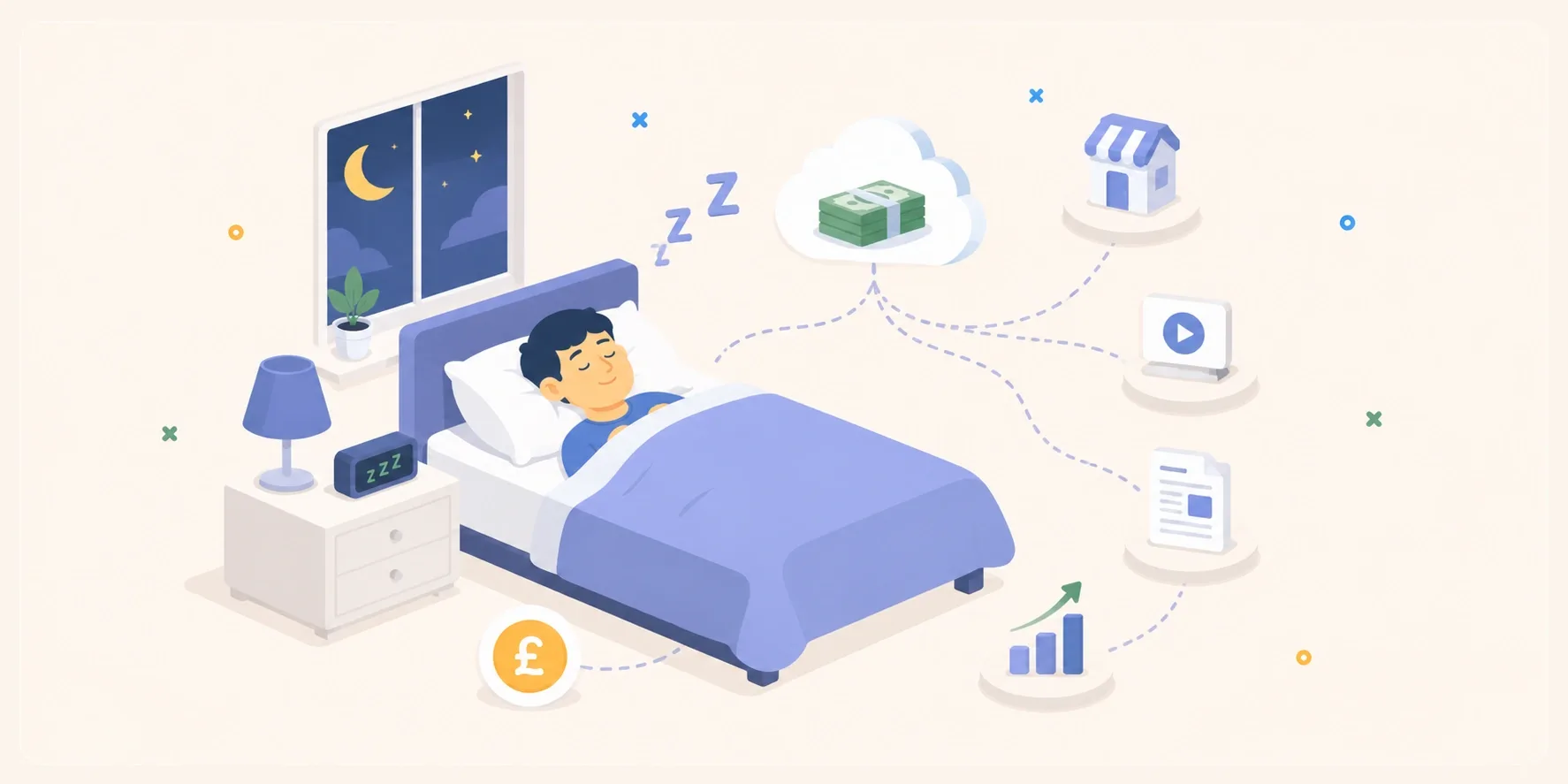
Most money stops the second you do. Passive income is the kind that keeps paying while you sleep. One line captures why that matters so much:
You will only be financially free when your passive income exceeds your expenses.
T. Harv Eker, Secrets of the Millionaire Mind
Read that again. Freedom is not earning more by working more hours.
It is building income that arrives on its own — while you sleep, travel, or do nothing at all — until it quietly covers what you spend.
The catch nobody says out loud: most passive income needs money upfront, or months of work, before the first euro lands. So this guide ranks every option by what it really pays — the biggest, hardest earners first, and the free, nothing-down ones last.
Making money while you sleep in two ways
Before the methods, here is the one idea this whole guide rests on. Passive income is money that keeps coming after the work is done. It splits into two very different paths.
Nothing down to start
A small set of options that need no money, no skill, and no daily effort. You switch them on and they earn in the background.
Earns eventually
Most "passive" ideas live here. They need capital, like savings or stocks, or upfront building, like content or products, before they pay you while you sleep.
Knowing which kind you are looking at kills the scam fear and sets realistic expectations. Next, every option ranked by what it actually pays — biggest earners first, free nothing-down ones last.
Earn money while you sleep, with money or work first
Here is every option in one list, ordered from the biggest earner to the smallest. The pattern is simple: the more a method pays, the more money or upfront work it asks for first.
1Dividend stocks or index funds
This is the classic way money makes money. You buy a slice of companies — single shares, or a fund that holds hundreds at once — and they pay you a small share of their profits, called a dividend. The cash usually lands a few times a year, with no work from you.
Index funds are the simplest version. A fund that tracks something broad, like the S&P 500 or a global all-world index, spreads your money across many companies in one move. Big providers such as Vanguard, iShares and Fidelity all offer low-cost ones. Some funds pay the dividends straight to you; others reinvest them so your balance compounds.
A quick example. Say you hold €10,000 in a fund yielding 2% — that is about €200 in dividends a year, paid in instalments. On its own that is small. The financially sound move is to reinvest them: those dividends buy more shares, which pay their own dividends, so over years the compounding builds your balance far more than the headline yield alone suggests.
Real risk and fees apply
This is the one option here with real risk — prices go up and down, and a fund can be worth less than you paid. Fees eat into returns, so compare the yearly cost (the "expense ratio") before you buy.
None of this is financial advice; if you are unsure, speak to a regulated adviser.
2Renting out an asset
If you already own something useful, you can rent it out and let it earn between uses. This is often the biggest steady sum on the list, because you are charging real money for real things.
The trick is to look past the obvious spare room. People rent out parking spaces, driveways, storage corners, camera gear, power tools, even their car when it would otherwise sit on the drive.
Where to list things (availability varies by country):
- Airbnb — a spare room or a whole place
- JustPark — a parking space or driveway
- Neighbor — spare storage or garage space
- Turo — your car
- Fat Llama — cameras, tools, gadgets and gear
Only partly passive — check the rules
It is only partly passive — there is messaging, handover and cleaning. Check your insurance covers renting, and look up the local rules, as some cities limit short stays.
3Interest on savings you already have
If you already have a balance sitting in your bank, the laziest win is to make sure it actually earns. A high-interest savings account or money market account pays you interest every day — weekends and nights included — for doing nothing.
The catch is that many everyday current accounts pay almost nothing. Moving the same money into a savings account, a money market account, or a fixed-term deposit can turn a near-zero rate into a real one.
A quick example. The same €3,000 earns next to nothing in a typical current account, but about €105 a year in one paying 3.5% — that gap is the real win, just for moving the money once. Keep in mind rates can change, and if inflation runs higher than your rate, your balance still loses a little buying power.
Before you move money. Compare current rates (comparison sites like NerdWallet or your country's own list them), check whether you can withdraw freely or the cash is locked for a term, and make sure the bank is covered by your country's deposit protection scheme.
Make money in your sleep
Money SMS pays you for the test SMS your phone quietly receives while you sleep. Free to start, €1M+ paid out, €2 minimum to cash out.
4Digital products
A digital product is something you make once and sell again and again, with nothing to ship. Think templates, planners, presets, fonts, icons, or printables people download the moment they pay.
The money is in solving one small, specific problem really well. A budgeting spreadsheet, a set of photo presets for food shots, a planner template for freelancers — narrow ideas sell better than broad ones.
Where to sell.
- Etsy — printables, planners, wall art and templates
- Gumroad — any digital file, with a simple checkout
- Creative Market — fonts, graphics and design assets
- Payhip — sell from your own page, no store needed
The effort is all upfront
The first sales can be slow. It only turns passive once the product is built and people can find it, so spend real time on a clear title and good preview images.
5An online course or workshop
If you can teach a skill other people want to learn, you can record it once and sell that course again and again. A class you film, a software walkthrough, a step-by-step skill — you build it once, and new students keep paying to watch long after.
The sweet spot is a practical skill with a clear result: spreadsheets for beginners, watercolour painting, coding a first app, or passing a specific exam. Narrow and useful sells better than broad and vague.
Where to publish (availability varies by country):
- Udemy — a huge marketplace that brings its own students
- Stepik — strong for coding, tech and academic topics
- Teachable or Thinkific — host and sell from your own branded page
Marketplaces take a cut
On a marketplace like Udemy or Stepik you reach more students, but the platform takes a share of every sale and often sets the price during promotions. Selling from your own page keeps more per sale, but then finding students is your job. Either way, the recording and editing is real work upfront.
6Content with a long tail
Some content keeps earning for years after you publish it, because people keep finding it through search. A how-to video, an ebook, or a library of stock photos can pay a little month after month, long after the work is done.
The key word is evergreen — topics people will still search for next year, not just this week. "How to clean a cast-iron pan" will outlast any news story.
Where to publish and earn.
- YouTube — videos earn ad revenue once you qualify
- Amazon Kindle Direct Publishing — self-publish an ebook
- Shutterstock and Adobe Stock — sell photos, video and illustrations
It rewards patience, not one upload
The payments per view or sale are usually tiny, and it can take months to build a back catalogue big enough to add up. It rewards patience and volume, not a single upload.
7A website or vlog with affiliate links
A blog, a niche website, or a video channel — a vlog — can keep earning for years from content you publish once, mostly through affiliate marketing. You recommend something you actually use, link to it, and earn a small commission when someone buys through your link. The post or video keeps paying every time a new person finds it.
Affiliate marketing is the engine here. A "best budget headphones" review, a recipe page that links to the exact pan, or a desk-setup video with links to the gear — each can quietly earn long after you hit publish.
Where to start (availability varies by country):
- WordPress — the most common way to build a blog or site
- YouTube — the usual home for a vlog
- Affiliate programs like Amazon Associates, or networks such as Awin and CJ Affiliate
A slow build, not a switch
This is one of the slowest burns on the list. It can take many posts or videos, and months of search traffic, before the commissions add up to much. Only recommend things you would genuinely use — readers and search engines both punish thin, spammy affiliate pages.
Ways to make money while you sleep with free apps
Everything above needs money to invest, an asset to own, or real work to build first. This last group needs none of that — just a free app or account you set up once.
Most run quietly in the background and pay you small amounts for almost nothing. These are often called beer money apps, because each one pays just a little.
None will replace a salary, but they are the cheapest way onto the list, with no money down.
8Cashback that lands later
Cashback pays you a small percentage back on shopping you were going to do anyway. You do not earn it from nothing — but on spending you cannot avoid, like groceries or travel, it is real money back for almost no effort.
It works through apps, browser add-ons, or a card linked to offers. You buy as normal, the purchase tracks, and the cash lands in your account days or weeks later — often while you sleep.
Popular options (availability varies by country):
- Rakuten — cashback at thousands of online shops
- TopCashback and Quidco — strong in the UK
- The "rewards" or "offers" built into your own bank or credit-card app
Only count what you'd buy anyway
Only count it on things you would buy anyway — chasing cashback into extra spending defeats the point. Check the minimum payout too, as some apps hold your balance until you reach a threshold.
9Sharing your internet bandwidth
Some free apps pay you for sharing a slice of your unused internet connection. They run quietly in the background once installed, so this one is genuinely passive — your phone or computer earns while you do nothing.
- Honeygain — the best known, for desktop and mobile
- EarnApp — from the team behind Bright Data
- Pawns.app — shares bandwidth, with optional surveys on top
The money is small
Bandwidth apps run on their own, but they pay little — often only cents a day, depending on your country and connection. Check each one is trusted and available where you live, and never pay to join.
10Get paid for sharing your data
A few apps and panels pay you a small, steady amount for sharing anonymised data about how you use your phone or browse the web. You install them once, they run quietly in the background, and the payout arrives on a schedule — no tasks, so this one is genuinely passive.
- Nielsen Computer & Mobile Panel — a long-running market-research panel
- Tapestri and Caden — pay a monthly amount for sharing app or usage data
Know what you are sharing
You are trading a little privacy for the payout, so read what each app collects before you join, stick to well-known names, and check you can opt out and delete your data later. As always, never pay to take part.
11Let your phone earn for you
A few Android apps pay you for the test text messages your phone receives in the background. Telecom companies need real phones in real countries to confirm their messages arrive, and your phone quietly does that job while you sleep — no tasks and no daily check-ins, so it is genuinely passive once set up.
Money SMS is one of these apps: free to install, with a €2 minimum cashout. You can read exactly how to earn money by receiving SMS before you start.
A few euros a month, no more
This will not replace a salary — most people earn a few euros a month, more in some countries, depending on how many test messages route through your number. Stick to trusted apps, and never pay to take part.
How to make money in your sleep: every option compared
The whole list in one view, in the same order — ranked by what each really pays, most at the top, least at the bottom.
| Method | Money to start | What it really pays | Passive? |
|---|---|---|---|
| Dividend stocks / funds | Capital | Returns, with risk | No |
| Rent out an asset | The asset | Steady, partly passive | Partly |
| Savings interest | Your savings | Tied to your balance | If you have savings |
| Digital products | Low | Varies widely | No — build first |
| Online course / workshop | Low | Good, if it sells | No — record first |
| Content (video, ebook) | Low | A long tail, if it lands | No — build first |
| Website / vlog (affiliate) | Low | Commissions, long tail | No — build first |
| Cashback apps | None | % of your spending | Almost |
| Bandwidth-sharing apps | None | Cents a day | Yes |
| Data / research apps | None | A monthly payout | Yes |
| SMS-receiving apps | None | A few € a month | Yes |
If you have money to invest, savings interest and index funds are the calm, hands-off route. But if you have no spare cash, the answer is shorter: a free passive app, cashback on what you already buy, and whatever interest you can earn on any savings you have.
Frequently asked questions
Is making money while you sleep real, or a scam?
It is real, but the phrase is often used to sell scams. Genuine passive income keeps paying after the work is done — either work you put in upfront, or money you invested. Be wary of anything that promises big overnight earnings with no money and no effort. The real options pay small amounts, and that is the sign you are looking at a genuine one.
Can you earn money while you sleep with no money to invest?
Yes, but the list is short. A free passive app like Money SMS, cashback on shopping you already do, and interest on any savings you have are the realistic options. Everything else, like stocks, digital products, or content, needs either capital or weeks of work before it pays you overnight.
How much can you realistically earn while you sleep?
For free passive apps, think a few euros a month, not a salary. Cashback depends on how much you spend, and savings interest depends on your balance. Anyone promising hundreds a night for free is not telling the truth. The point of the free tier is steady extra money for zero effort, not a replacement income.