

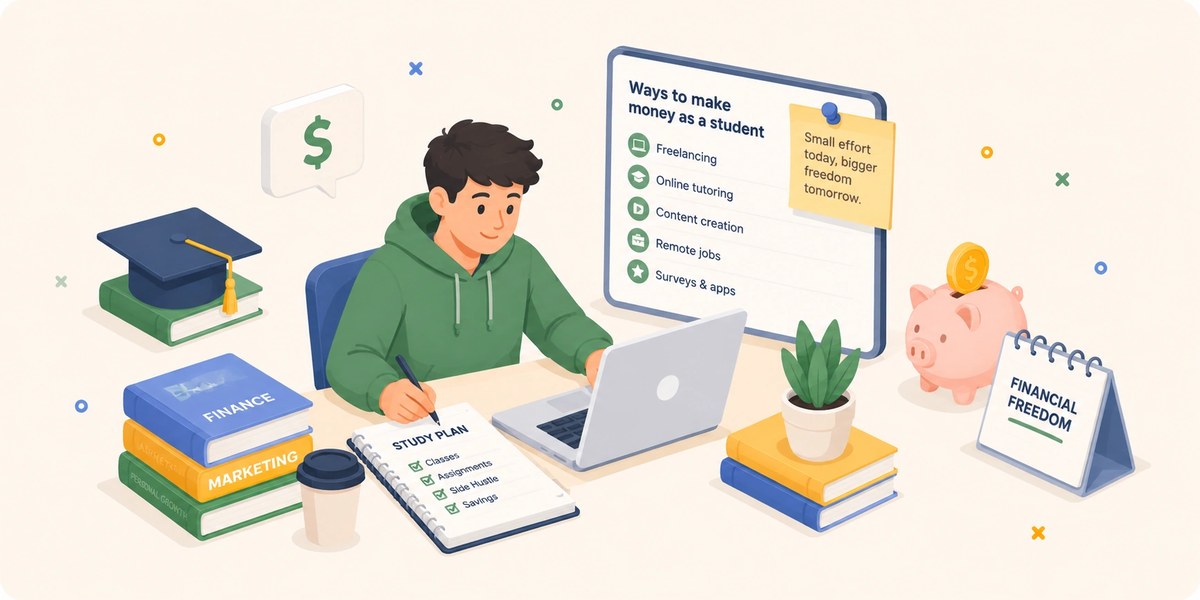
Being a student usually means more month than money.
Your loan goes on rent, the good jobs want hours you don't have, and your timetable never sits still. That's why most advice on how to make money as a student never quite fits.
So here's the friendly version: don't chase hours you don't have. Get paid for what you're already doing instead.
Some of the best ways for students to make money are hiding in your normal week: idle phone time, the subjects you're revising, your student card, a spare afternoon.
Below are 20 honest ways to make money as a student, grouped by what you can spare. Working out how to earn money as a student is just picking what fits, not finding extra time.
Use the quick guide to jump to your week. No get-rich-quick nonsense.
The best ways to make money as a student, at a glance
The right choice depends on what you can spare. Here's where to start:
- Want money with zero effort?Set up background apps like SMS testing and forget them.
- Got 10 minutes between lectures?Paid research studies and refer-a-friend bonuses fill small gaps.
- Need cash fast this week?Pick up a local odd job or a delivery shift.
- Want the best hourly pay?Tutor a subject you aced or freelance a skill from your course.
Ways to earn money as a student online, on autopilot
If you're working out how to earn money as a student online, or simply how to earn money online for students with the least effort, start here.
These take little or no effort once you're set up, and you can run several at once. A couple, like SMS testing and cashback, even tick along in the background while you study.
1. Open a student bank account that pays you
Some of the easiest money you'll make as a student is for opening the right bank account.
Banks compete hard for students, because you often stay with your first account for years. To win you over, many hand out a cash welcome bonus, a long interest-free overdraft, or freebies like a railcard or gift vouchers when you open or switch to a student account.
It's close to free money for an hour of admin: compare the current student accounts, pick one that genuinely suits you, and apply online. A welcome bonus of around €100 is common, and an interest-free overdraft can save you far more if you ever dip into it.
Switch for the account, not just the freebie
A bonus is only worth it if the account actually fits you. Check the overdraft terms, any fees, and whether you keep the perks after first year. Don't open accounts you won't use just to chase bonuses, as several applications in a short time can dent your credit record.
2. Stack cashback on top of your student discount
You already get a student discount through services like UNiDAYS and Student Beans.
Fewer students know you can stack cashback on top of the same purchase for a second saving. Cashback sites like TopCashback and Quidco pay you back a slice, usually 1%–10%, when you shop through them at places you'd use anyway: your weekly food shop, train tickets home, a new laptop. They pay out in real cash to PayPal or your bank.
Use the student code and the cashback link together, but only for things you were going to buy. A discount on something you don't need still costs you money, and cashback can take weeks to confirm.
3. Get paid for receiving test SMS
This is about as close to free money as a student gets.
Mobile networks send millions of texts a day and need proof those messages actually arrive, so they fire test messages to real phones around the world. Apps like Money SMS and McMoney turn your phone into one of those test points.
The app quietly receives automated test SMS in the background and pays you for each one. It reads only the test codes, so your own messages are never opened.
Setup is a five-minute job: install it, allow it to receive the test SMS, and leave it alone. From then on it earns while your phone sits in your bag during a lecture, and cashes out in real money, usually to PayPal.
Money SMS: earn while you study
Get paid real cash for the test SMS your phone receives in the background, even during lectures. Free to start, trusted for 10+ years, €1M+ paid out, €2 minimum to cash out.
Turn your studies into money
This is where being a student pays best.
The subjects you're studying, the notes you take, and the skills your course is building are all things people will pay you for right now, often at the highest hourly rates on this list.
4. Get paid for research studies
This is the best-kept secret on most campuses.
Universities and research platforms pay people to take part in studies, from quick online questionnaires to in-person lab experiments, and students are exactly who they're after. Academic platforms like Prolific pay noticeably better than ordinary survey apps, often €7–€14 an hour, because the research needs careful, honest answers.
Your own psychology and economics departments usually run paid studies too, pinned to notice boards and emailed round. Keep a profile on a research platform and actually read your student email, and the studies will come to you.
Places are limited, though, so they fill fast.
5. Sell your lecture notes
If you take clear, organised notes, students on the years below will pay for them.
You've already done the work for your own revision, so this is income from effort you'd put in anyway. Platforms like Stuvia and Nexus Notes let you upload summaries, essay plans, and study guides, then pay you each time someone buys.
Notes for big core modules sell again and again, year after year, with nothing more to do once they're uploaded. Give them honest, specific titles, and check your university's rules on sharing course material first.
6. Tutor the subject you just aced
The A-level or GCSE subjects you did well in are still fresh, which makes you a brilliant tutor for the students coming up behind you. It's flexible and among the best-paid work a student can do.
Apps like MyTutor, Tutorful, and Superprof match you with pupils, handle the payment, and let you teach by video around your timetable. Rates commonly run €18–€35 an hour, more for exam years and university-level help.
It's live work, so you have to show up on time, but few student jobs pay this well per hour.
7. Freelance the skill your course is building
Your degree is teaching you something people pay for: writing, design, coding, data, languages, or even building a tidy spreadsheet.
Freelance platforms connect that skill with paying clients worldwide. Sites like Fiverr and Upwork let you list what you offer, take on small jobs, and message clients from your phone. Jobs run from €6 quick tasks to hundreds for bigger projects.
It's slow at the start while you gather reviews, so begin small, and you'll finish university with a real portfolio and income on the side.
8. Get paid to take notes for other students
If your notes are clear and reliable, your university will often pay you to take them for someone else.
Disability and accessibility support teams hire student note-takers to sit in lectures alongside a classmate who needs the help, so you get paid for notes you'd be writing anyway. Ask your university's disability or student support office how to apply; most run their own scheme and pay by the hour or the lecture.
It fits perfectly into your timetable, since you're in the room regardless, and it reads well on a CV. Places are limited, and you'll usually need a short check or some training first.
More ways to make money as a student on campus
Some money is open to you simply because you're enrolled.
These quick, sociable earners fit between lectures, and most of them quietly disappear the day you graduate, so make the most of them now.
9. Become a campus brand ambassador
Brands pay students to represent them on campus: handing out samples, running stalls, posting on social media, or putting on small events.
It's sociable work that fits naturally into student life. Roles are listed on platforms like RateMyPlacement and Student Circus, and on your students' union jobs board.
Pay is often €12–€18 an hour, sometimes with free products and event tickets on top. It also reads well on a CV, so it pays you twice: cash now, and experience that helps you graduate into a job.
10. Cash in on refer-a-friend bonuses
You almost certainly use apps that will pay you to recommend them.
Banks, food delivery apps, taxi and e-scooter apps, and money apps nearly all run refer-a-friend schemes. When a friend signs up with your link and meets a simple condition, you both get a cash bonus or credit. Students are perfect for this, since you arrive somewhere new with a whole flat and course full of people setting up the same apps.
Share your link when something genuinely comes up, like a flatmate ordering their first takeaway or opening a bank account. Only recommend apps you actually rate, and never spam people, because a small bonus isn't worth annoying your friends.
11. Join paid focus groups and panels
Brands pay good money to hear what people your age actually think.
A focus group is a guided chat, online or in person, about a product, advert, or service. Sessions usually run 30 to 90 minutes, and because companies want honest opinions from students, you earn far more than you would from a quick survey. Platforms like Respondent and Angelfish Opinions list studies you can apply for.
Pay often runs €30–€80 a session, sometimes more for specialist topics. Places are limited and you have to be picked, so fill in your profile honestly and apply only for the ones that genuinely fit you.
12. Mystery shopping near campus
Mystery shoppers get paid to visit a shop, cafe, or restaurant and report back on the service.
Brands use it to check standards, and you pick up a fee and often a free meal or product. Apps like Roamler and BeMyEye list quick local jobs: photograph a display, check a price, or rate the service. Many pay €4–€9 and take only a few minutes around campus.
Read each task carefully and follow the brief exactly, because you only get paid for a report that's complete.
13. Pick up flexible shifts on campus
Your university is one of the biggest employers on your doorstep, and a lot of its work is built around student timetables.
Think bar and cafe shifts in the students' union, helping at open days, staffing the library or gym, ushering at events, or invigilating exams during term breaks.
Most roles are advertised on your students' union jobs board and the university's own careers page, and many let you pick shifts that fit around classes. The pay is steady hourly work rather than a windfall, but it's reliable, on campus, and run by people who understand you're a student first.
Active ways to earn money as a student in your spare time
When you've got a free evening, a quiet week, or the long summer, these pay the most.
They take real time or real effort, so save them for when your timetable allows rather than squeezing them into a busy term.
14. Pick up local tasks and odd jobs
Plenty of people near campus will happily pay for a job they don't want to do themselves.
Task apps connect you with one-off local work: flat-pack furniture to build, a flat to help move, a garden to clear, or a queue to stand in. You choose the jobs, set your price, and fit them around lectures. Apps like TaskRabbit and Airtasker handle the booking and payment for you.
Pay depends on the job, but handy, reliable students can earn a solid hourly rate, often more than a standard shift. Build up good reviews early and regular clients will start asking for you by name.
15. Food delivery and flexible gigs
If you'd rather earn offline with no fixed shifts, gig apps let you work whenever you're free.
They suit a free evening, a quiet study week, or the holidays. Apps like Deliveroo, Uber Eats, and Stuart pay you to deliver food by bike, often €10–€18 an hour in busy areas plus tips.
You start and stop whenever you like. Earnings track how busy your city is, so aim for evenings and weekends when orders peak; pay drops sharply when it's quiet.
Mind tax, visa limits, and your study balance
Gig work counts as self-employment, so you may need to register with the tax office and keep records. International students on a visa usually have a strict cap on term-time working hours, and this counts towards it, so check yours first. And whatever you take on, don't let earning money cost you the degree you're paying for.
16. Walk dogs and pet sit
If you'd take a study break to walk a dog anyway, you may as well be paid for it.
Plenty of busy owners near campus need someone to walk, feed, or check in on their pets during the day. Apps like Rover and BorrowMyDoggy connect you with local owners, handle the booking, and let you choose when you're free.
It's flexible, gets you outside, and regular clients can turn into steady weekly income. You'll need to be reliable and genuinely good with animals, and check you're allowed pets where you live if any stay over.
17. Babysit and help with childcare
Babysitting is one of the oldest student earners for a reason: it pays reasonably, it's often evenings and weekends when you're free anyway, and you can usually study once the children are asleep.
Local families, parents on your course, and apps like Bubble and Koru Kids all look for reliable sitters. Rates are commonly €10–€14 an hour, more for several children or a regular slot.
References and a friendly, trustworthy manner matter most, and some families will ask for a background check before they book you.
18. Take part in paid medical research
Medical research needs healthy volunteers, and it pays well for your time.
Universities, hospitals, and research clinics run paid studies on everything from sleep and diet to new treatments, and many recruit students because you're young, local, and often healthy. You might give a few hours for a one-off study or stay overnight for a bigger trial, with the pay rising for the more involved ones.
Always go through a registered clinic, university, or hospital, never an unknown advert. Read the consent form in full, ask about any risks, and remember you can stop at any point and still be paid for the time you've given.
19. Make short videos for brands
You don't need a big following to get paid for content any more.
Brands now pay for user-generated content, or UGC: short, honest-looking videos of their product that they post on their own channels and ads. You're paid for the video, not for views, so no audience is required.
You film simple clips on your phone, like an unboxing, a quick demo, or a 'how I use it' piece, and deliver them to the brand. Find work through creator marketplaces and by pitching brands you already like.
A good clip can pay €25–€120 or more, and student life makes for relatable content. It takes practice to film well, and your first few jobs will pay less while you build samples.
20. Start a student content channel
Short-video and streaming platforms can pay creators, and the ceiling is higher than anything else here. The catch is that very few people reach it.
On TikTok, YouTube, and Instagram you can earn through creator funds, brand deals, tips, and your own products. Student life, from budgeting to revision and 'a day in my degree', is a popular niche with a ready-made audience of other students.
It takes months of consistent posting to build a following, so treat it as a long-term project, not quick cash.
The money traps that target students (and how to dodge them)
Students are a prime target for the people behind these, partly because money is tight and partly because some traps are dressed up as easy student jobs.
A few aren't just a waste of time, they're illegal and can end your studies. Here are the ones to know:
- Money muling. Someone offers you cash to receive money into your bank account and pass most of it on, or to 'borrow' your account or card details. This is money laundering, even if you didn't know where the money came from. It can get your account frozen, leave you blocked from banking for years, and end in a criminal record. No legitimate job ever needs to run money through your personal account.
- Fake 'student jobs' and recruiters. Adverts promising easy money as a brand rep, mystery shopper, or 'admin assistant' that then ask for a joining fee, your bank login, or an upfront payment for a 'starter kit'. Real employers pay you, not the other way round.
- Essay writing 'work'. Sites that pay you to write essays or coursework for other students. Beyond the obvious, helping others cheat is academic misconduct, it is now illegal to provide these services in parts of the UK, and getting involved can put your own place at university at risk.
- Upfront fees and 'guaranteed income' courses. Any app, scheme, or course that asks you to pay before you can earn, or promises a set figure like '€600 a week from your phone'. Genuine earning apps and student jobs are free to join, and no honest one guarantees an amount.
Whatever the offer, treat these as instant warning signs and walk away:
- It involves your bank account or card details up front. Anyone asking to move money through your account, or for your login or full card number before you've earned anything, is a fraud risk, not an employer.
- It asks you to pay to start or to 'unlock' earnings. Joining fees, deposits, and paid starter kits are the clearest sign of a scam.
- The pay sounds too good for the work. Big, fast, guaranteed money for almost no effort is bait. Real student earnings are modest and build up slowly.
- There's no real company behind it. No name, no address, no support, and reviews full of people who were never paid. If others can't get their money out, you won't either.
If something feels off, it usually is.
A genuine opportunity is free to join, pays into your account rather than through it, and is run by a company you can actually find and contact.
When in doubt, your students' union and university support team can tell you whether a 'job' is safe before you hand over anything.
How much can you earn as a student?
Be honest with yourself: none of this replaces a part-time job, your loan, or a parent's help, and any app claiming it will is one to avoid.
As a rough monthly guide:
- Background earners (SMS testing, cashback, refer-a-friend bonuses): pocket money, perhaps €12–€45 a month combined
- Campus and quick work (research studies, focus groups, mystery shopping, notes): €60–€175 a month in term time if you keep at it
- Skills and active work (tutoring, freelancing, delivery, childcare, odd jobs): up to several hundred a month, but it's real hours, best saved for holidays
- Match the method to the term. Run background earners and quick campus tasks during busy weeks, and save tutoring, freelancing, and delivery for free afternoons and the holidays when your timetable opens up.
- Lean on what makes you a student. Paid research on campus, the notes and subjects you've just mastered, and student discounts stacked with cashback all pay you for things others can't access.
- Protect the degree first. If a side earner starts cutting into lectures, reading, or sleep, scale it back. The qualification is the real long-term payoff you're here for.
Frequently asked questions
What is the easiest way to make money as a student?
Background apps are the easiest, because they run on their own after a quick setup. SMS testing apps like Money SMS are a good example: free to start, no skill, and no money needed. They only pay a few euros a month, so pair one with a campus earner like paid research studies or selling your notes for more.
What's the best way to earn money as a student online?
Plenty of online options are completely free to begin. Research platforms like Prolific, paid focus groups, selling your lecture notes, freelancing a skill, and SMS testing apps all cost nothing to join. You should never have to pay an upfront fee to start a genuine earning app or student job.
Can I earn money without it hurting my studies?
Yes, if you pick methods that fit your timetable. Background apps need no attention, and research studies or paid focus groups fill the gaps between lectures. Keep the more demanding work, like tutoring, freelancing, and delivery, for evenings, weekends, and holidays so it does not eat into study time.
Do international students need to be careful about working?
Often yes. Many student visas set a strict limit on how many hours you can work in term time, and gig and freelance work usually count towards it. Check the exact rules on your visa before you start, and bear in mind that self-employed earnings may need to be reported to the tax office.
How can I make money as a student with no money to start?
You don't need a penny to begin. The free options in this guide cost nothing to join: SMS testing, paid research studies, focus groups, refer-a-friend bonuses, mystery shopping, and selling your lecture notes. Most only ask for a little time between lectures. Use that as a filter too: any app, course, or starter kit that wants money from you before you can earn is one to skip, because genuine earning apps and real student jobs never charge you to join.